A
An STS water meter, short for "Standard Transfer Specification" water meter, operates based on advanced electronic metering and communication technologies. It uses a built-in high-precision flow sensor to monitor water flow in real time. When water passes through the meter, the sensor captures physical signals generated by the water flow, such as pulse signals caused by changes in flow rate. These signals are accurately counted and converted into corresponding water volume data, a process that ensures the accuracy of water consumption measurement.
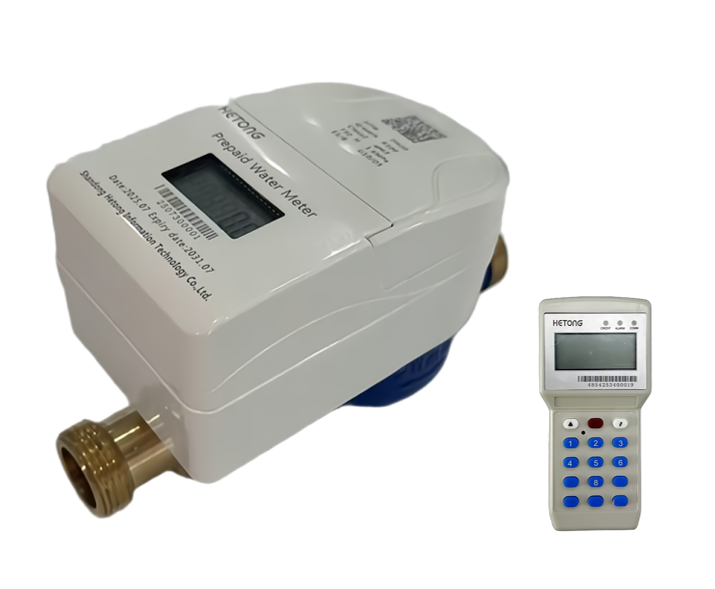
Prepaid billing systems are widely used in the current public utility sector, with their core being the "pay first, use later" model. Users need to purchase a certain amount of water from the water supply service provider in advance, pay the fee in monetary form, and then obtain the corresponding water usage quota.
From a technical perspective, STS water meters have the conditions to support prepaid billing systems. Firstly, their advanced microprocessors and communication modules serve as an important foundation for implementing prepaid functions. The powerful data processing capability of the microprocessor allows it to efficiently handle prepaid-related data, such as the conversion of recharge amounts into corresponding water volumes, and the real-time calculation and storage of balances. The communication module ensures smooth data exchange between the water meter and the external prepaid management system. It can promptly receive user recharge information and feed back the meter’s real-time status (such as remaining water volume and water usage records) to the management system.
The functions of STS water meters are highly compatible with the requirements of prepaid billing systems. In a prepaid billing system, the water meter needs to have functions such as real-time water usage monitoring, accurate water volume deduction, and balance warning—all of which are well-implemented in STS water meters. In terms of water usage monitoring, STS water meters can capture water flow signals in real time and continuously monitor the user’s water consumption. As soon as the user turns on the faucet, the meter starts measuring immediately and updates the water consumption data in real time, allowing the prepaid system to keep track of the user’s water usage dynamics at all times.
In a water supply project in a city in South Africa, the local water supply company installed a large number of STS water meters and matched them with a prepaid billing system to solve the problems of unpaid water fees and low efficiency of manual meter reading. The project covered thousands of residential and commercial users.
The support of STS water meters for prepaid billing systems brings significant advantages in multiple aspects. From the perspective of water supply management departments, management convenience is greatly improved. Through the prepaid system, the management department no longer needs to spend a lot of manpower and time on monthly meter reading, nor does it need to handle complex processes of urging unpaid fees. The system can automatically record users’ recharge and water usage, generate detailed reports, and facilitate the management department to conduct data analysis and resource planning. For example, by analyzing user water consumption data, the management department can understand water consumption peaks in different regions and seasons, so as to make water supply scheduling arrangements in advance and ensure the rational allocation and efficient use of water resources.
However, in practical applications, the support of STS water meters for prepaid billing systems also faces some challenges. Technical failures are one of the issues that cannot be ignored. Although STS water meter technology is relatively mature, electronic devices may inevitably fail. For example, a faulty communication module may prevent recharge information from being transmitted to the meter in time, or the meter may fail to upload water consumption data to the management system; a faulty microprocessor may affect the accuracy of water volume measurement and balance calculation. Once these failures occur, they will not only bring inconvenience to users (such as inability to use water normally or being incorrectly charged), but also cause difficulties for the operation and management of water supply management departments, increasing maintenance costs and management difficulty.


