|
| Quantity: | |
|---|---|
The Ultrasonic Water Meter represents a significant advancement in water measurement technology, utilizing sophisticated ultrasonic principles to provide accurate, reliable flow measurement across various applications. Unlike traditional mechanical meters that rely on moving parts, this full-electronic water meter employs the transit-time differential method to calculate water flow by measuring the time difference between ultrasonic pulses traveling with and against the fluid flow. This non-intrusive measurement approach eliminates wear and tear, ensuring long-term stability and reduced maintenance requirements. Compliant with GB/T 778.1~3-2007 and CJ/T 224-2012 standards, the ultrasonic water meter delivers precise measurement for both cold and hot water applications in residential, commercial, and industrial settings. Its advanced design makes it an essential tool for water utilities, facility managers, and environmental monitoring professionals seeking accurate consumption data and efficient resource management.
At the core of this meter's performance is the transit-time differential method, which measures the difference in propagation time between ultrasonic signals traveling upstream and downstream in the water flow. This difference is directly proportional to flow velocity, allowing for highly accurate calculation of water volume. The technology works effectively with clean, homogeneous liquids and requires fully filled pipes for optimal performance.
Rated as Class 2 according to international standards, this ultrasonic water meter ensures precise measurement across a wide flow range. This accuracy class guarantees reliable performance in both low-flow and high-flow scenarios, making it suitable for applications where consumption patterns vary significantly throughout the day.
Constructed to withstand demanding operational environments, the ultrasonic water meter features a rugged housing that protects sensitive electronic components from external damage. The absence of moving parts eliminates mechanical wear, significantly extending the meter's service life compared to traditional mechanical alternatives.
Engineered for energy efficiency, the meter's internal design minimizes pressure loss in the water system. This design characteristic ensures that water pressure remains stable throughout the plumbing network, reducing energy consumption for water pumping and distribution.
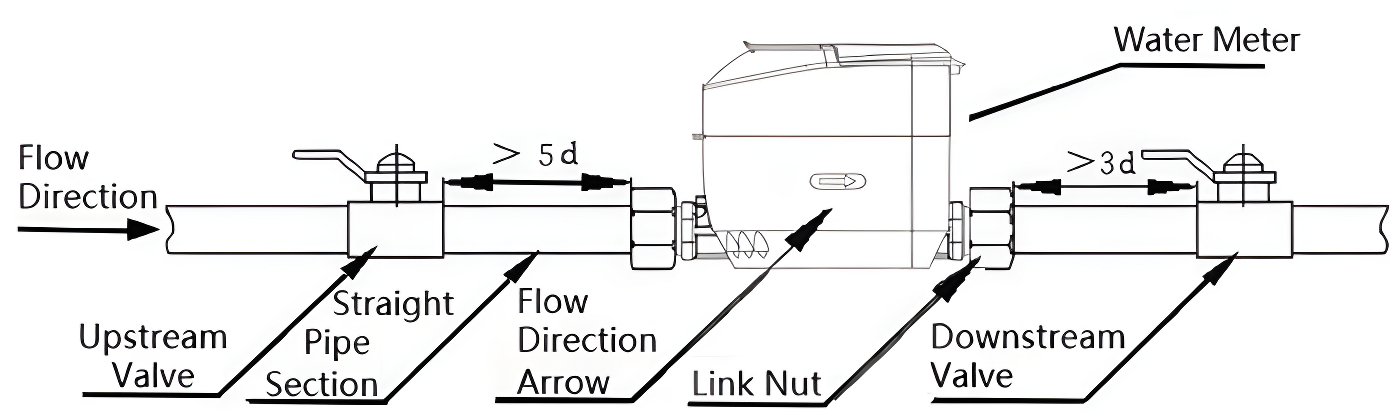
The ultrasonic water meter supports various installation configurations, including horizontal and vertical orientations (with specific models), providing flexibility for different plumbing layouts. This versatility makes it suitable for both new construction projects and retrofitting into existing water systems.
Water utilities benefit from the meter's accuracy and durability for billing purposes and network management. The precise measurement data helps identify consumption patterns, detect leaks, and optimize water distribution throughout the municipal network.
Office complexes, hotels, and shopping centers utilize these meters to monitor water consumption, manage costs, and implement water conservation measures. The accurate measurement across variable flow rates ensures fair tenant billing and efficient facility management.
In industrial settings, the ultrasonic water meter provides critical data for process control and resource management. It accurately measures water usage in manufacturing processes, cooling systems, and facility operations, helping companies monitor efficiency and comply with environmental regulations.
Schools, hospitals, and government facilities rely on these meters to track water consumption, manage budgets, and maintain infrastructure. The long-term reliability reduces maintenance costs and ensures continuous operation of essential water services.
Environmental agencies and water management districts use ultrasonic water meters for monitoring water distribution, tracking usage patterns, and implementing conservation strategies. The data collected helps in sustainable management of water resources and planning for future needs.
Unlike mechanical meters that use moving parts to measure water flow, ultrasonic meters use sound waves to calculate flow velocity. This non-intrusive method eliminates wear from friction, resulting in longer service life, more consistent accuracy, and reduced maintenance requirements.
The transit-time method works by sending ultrasonic pulses between two sensors, one upstream and one downstream. When water is flowing, the pulse traveling with the flow arrives faster than the pulse traveling against the flow. The difference in transit times is proportional to the water velocity, which is then used to calculate volume flow rate.
Yes, specific models are designed to measure both cold and hot water applications. These models are constructed with materials that can withstand higher temperatures and are calibrated to maintain accuracy across the expanded temperature range.
Technical Specifications
Performance | Parameters |
Accuracy class | Class 2 |
Nominal diameter | DN15~DN40 |
Range Ratio | R500 |
Max.working pressure and pressure loss | 1.6MPa ΔP40 |
Working environment | Temperature:-25℃~70℃;Humidity≤100% |
Temperature Class | T30; T50 |
Flow profile sensitivity | U0/D0 |
Climatic ambient conditions | O |
Electromagnetic Class | E1 |
Output(optional) | NB-IoT/ 4G-Cat.1/ M-Bus/ RS485/OCT Pulse/4-20mA |
Cumulative flow:0.001m3, Instantaneous flow: 0.001 m3/h, water temperature: 0.01℃ | |
Calibration Mode Resolution | Cumulative flow:0.001L |
Power Supply | DC 3.6V Lithium Battery |
Material | Copper |
Protection Class | IP68 |

Flow Data
Nominal diameter (DN) mm | Range Ratio Q3 /Q1 | Q4 | Q3 | Q2 | Q1 |
m3/h | |||||
15 | 250 | 3.125 | 2.5 | 0.016 | 0.010 |
400 | 0.010 | 0.006 | |||
500 | 0.008 | 0.005 | |||
20 | 250 | 5 | 4 | 0.025 | 0.016 |
400 | 0.016 | 0.010 | |||
500 | 0.0128 | 0.008 | |||
25 | 250 | 7.875 | 6.3 | 0.040 | 0.025 |
400 | 0.0256 | 0.016 | |||
500 | 0.0202 | 0.0126 | |||
32 | 250 | 12.5 | 10 | 0.064 | 0.040 |
400 | 0.040 | 0.025 | |||
500 | 0.032 | 0.020 | |||
40 | 250 | 20 | 16 | 0.100 | 0.064 |
400 | 0.064 | 0.040 | |||
500 | 0.0512 | 0.032 | |||
Produt Size
(DN) mm | L1 mm | L2 mm | W mm | H mm | D |
15 | 114 | 110 | 96 | 106 | G3/4B |
20 | 114 | 130 | 96 | 106 | G1B |
25 | 114 | 260 | 96 | 110 | G1 1/4B |
32 | 114 | 260 | 96 | 135 | G1 1/2B |
40 | 114 | 200 | 96 | 137 | G2B |
Installation Diagram